
A connected platform for evidence, review and action.
Configure the operating logic around your target state, evidence, requirements, authorised reviewers and outcomes - while preserving uncertainty and human decision rights.
Brief and target state
Source and evidence register
Requirements and checks
Findings and uncertainty
Review proposals
Actions and outcome record
A practical orchestration and assurance layer.
The engine sits above or alongside the systems teams already use. It provides the connected workflow and review record that spreadsheets, document stores, dashboards and specialist tools often leave fragmented.
Context and evidence layer
Registers briefs, documents, observations and approved source data while retaining provenance, version, recency, quality and review status.
Requirements and assessment layer
Represents obligations, method-specific checks and review criteria without pretending that every conclusion can be reduced to deterministic logic.
Review and authority layer
Routes findings and bounded proposals to people with the right decision authority, preserving accept, edit, reject and defer actions.
Actions and outcome layer
Turns unresolved findings into owned actions and produces a reproducible readiness or decision record linked to its supporting evidence.
Integration layer
Uses APIs and adapters to complement systems of record, identity, document stores and operational data rather than forcing wholesale replacement.
Asynchronous work layer
Queues extraction, external inspections and AI assistance so long-running work never blocks the user or silently changes the current review context.
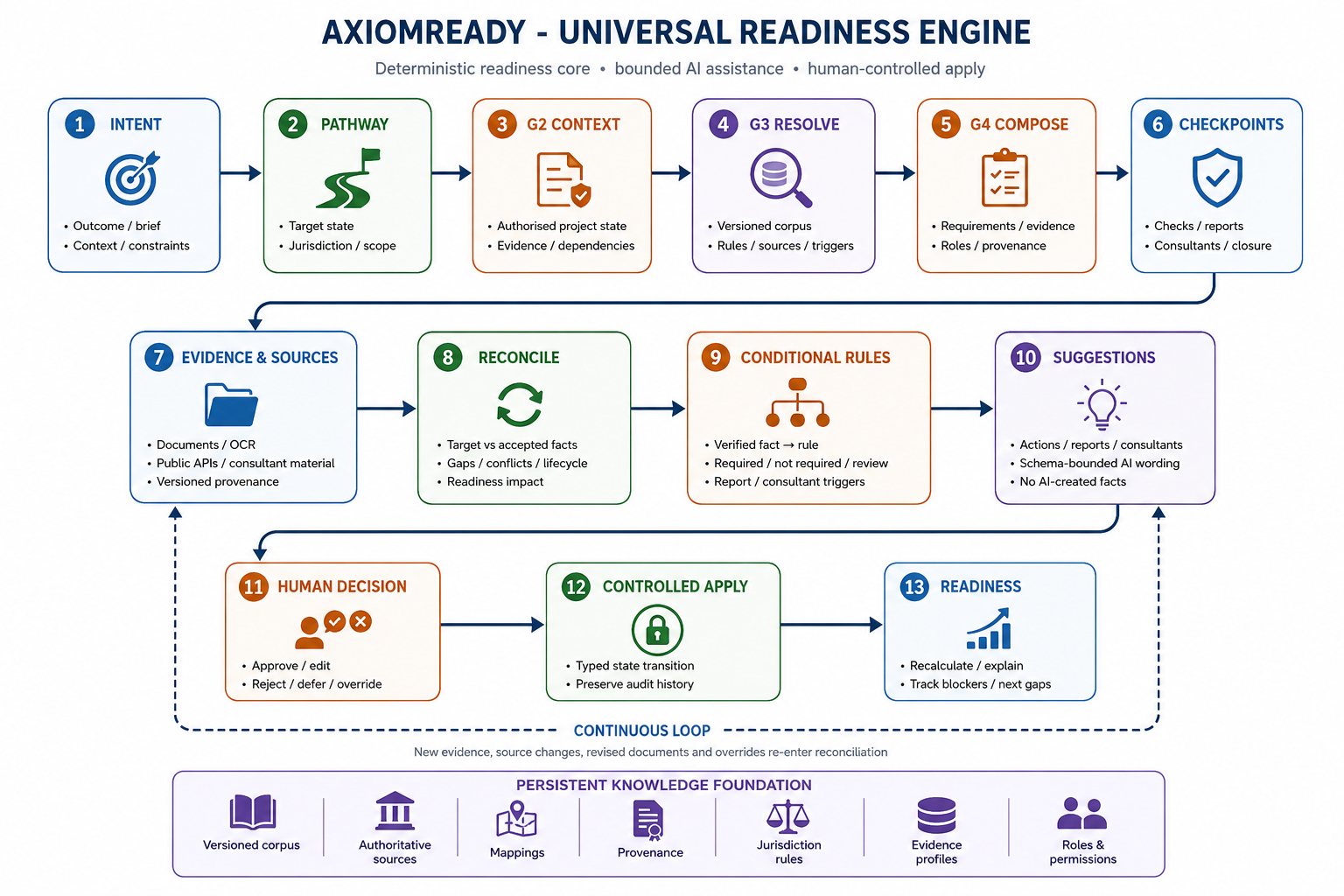
Every outcome remains connected to the cycle behind it.
The platform can be configured around a short operational gate or a multi-stage program, but the core record remains consistent.
Organise what is known
Register documents, observations and source data with provenance, version, timing, quality and review status.
Designed to support judgement, not impersonate it.
Axiom treats the boundary between deterministic checks, machine assistance and authorised human judgement as a core product requirement.
The platform can
- Organise evidence and provenance
- Make gaps, conflicts and uncertainty visible
- Prepare bounded review proposals
- Assign actions and preserve decisions
- Generate traceable readiness records
The platform does not
- Replace professional or research authority
- Guarantee statutory approval or compliance
- Treat AI output as an authorised decision
- Claim that all candidate domains are already deployed
- Require existing systems to be replaced
Long-running work stays in the background.
Extraction, approved external data checks and AI assistance follow one asynchronous pattern: queued, processing, ready for review, partial, failed or cancelled. Completion never steals focus or silently applies a result.
User-controlled review
When a job completes, the user can continue their current work. Only an explicit “check result” action moves them into the relevant review area, where evidence can be accepted, edited, rejected or deferred.
Why it matters
- No frozen interface while external work runs.
- No automatic focus jumps when a result arrives.
- No hidden mutation of evidence or conclusions.
- One predictable pattern across extraction, inspection and AI.
Configure the platform around one real decision cycle.
A pilot can validate users, evidence, controls, integrations and commercial value before a broader deployment.